

from Banyan Gold Corp. (CVE:BYN)
Banyan Intersects 1.67 g/t Au over 32.2 metres in the Airstrip-Powerline Gap at AurMac, Yukon
VANCOUVER, BC / ACCESS Newswire / November 23, 2026 / Banyan Gold Corp. (the "Company" or "Banyan") (TSXV:BYN)(OTCQB:BYAGF) is pleased to report results from a further five diamond drillholes from the ongoing 70,000 metre ("m") infill and expansion drill program at its wholly owned AurMac project in Canada's Yukon Territory. The latest results are from the Airstrip Deposit ("Airstrip") (Table 1).
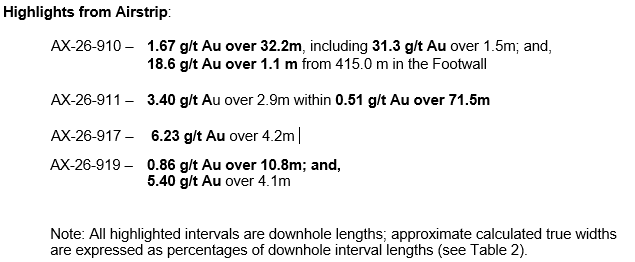
"AX-26-910 gives us a clear follow-up target in the Airstrip-Powerline gap," said Tara Christie, President and CEO. "The hole intersected 1.67 g/t gold over 32.2 metres, including 31.3 g/t gold over 1.5 metres, in the Cal 2 horizon. We interpret this intercept and an earlier intercept of 15.87 g/t gold over 2.2 metres in AS-25-817, roughly 500 metres away, to occur in the same horizon. Follow-up drilling will test the widths and how continuous the higher-grade mineralization extends between those intercepts and down-dip. The same hole also cut a separate high-grade quartz vein in the footwall, which we plan to test in 2027."
The drill results reported in this release were received after the data cut-off date for Banyan's Preliminary Economic Assessment ("PEA") and were not incorporated into the mineral resource model used for that study. These results, together with additional drilling completed during 2026, will be evaluated for incorporation into future mineral resource estimates and technical studies.
Since the PEA cut-off date, Banyan has completed over 225 drillholes totaling over 69,000 metres, with the drill program ongoing into December, providing a substantial additional dataset to support ongoing resource definition, expansion and project development work.
The AurMac Project hosts an Indicated Mineral Resource of 3.639 million ounces of gold ("Au") (167.3 M tonnes at 0.68 g/t) and an Inferred Mineral Resource of 4.985 million ("M") oz of Au (267.2 M tonnes at 0.58 g/t) (see MRE Table 3 below; as defined in the 2014 CIM Definition Standards for Mineral Resources and Mineral Reserves incorporated by reference into NI 43â101). The Airstrip deposit hosts a notably higher-grade Inferred Mineral Resource of 405,000 oz Au (15.1 M tonnes at 0.84 g/t Au), which the current results focus on extending while upgrading the Indicated portions of the deposit. Drillhole AX-26-910 intersected high-grade Au in a lower sulphide replacement horizon known as Cal 2: 1.67 g/t Au over 32.2 m. This intersection extends high-grade Cal 2 sulphide replacement mineralization, hosted in calcareous metasedimentary rocks, down-dip of the main Airstrip domains and into the Airstrip-Powerline Gap. Other drillholes in this release (AX-26-911, -917, -919, and -920) highlight extensions to higher-grade zones in central Airstrip.
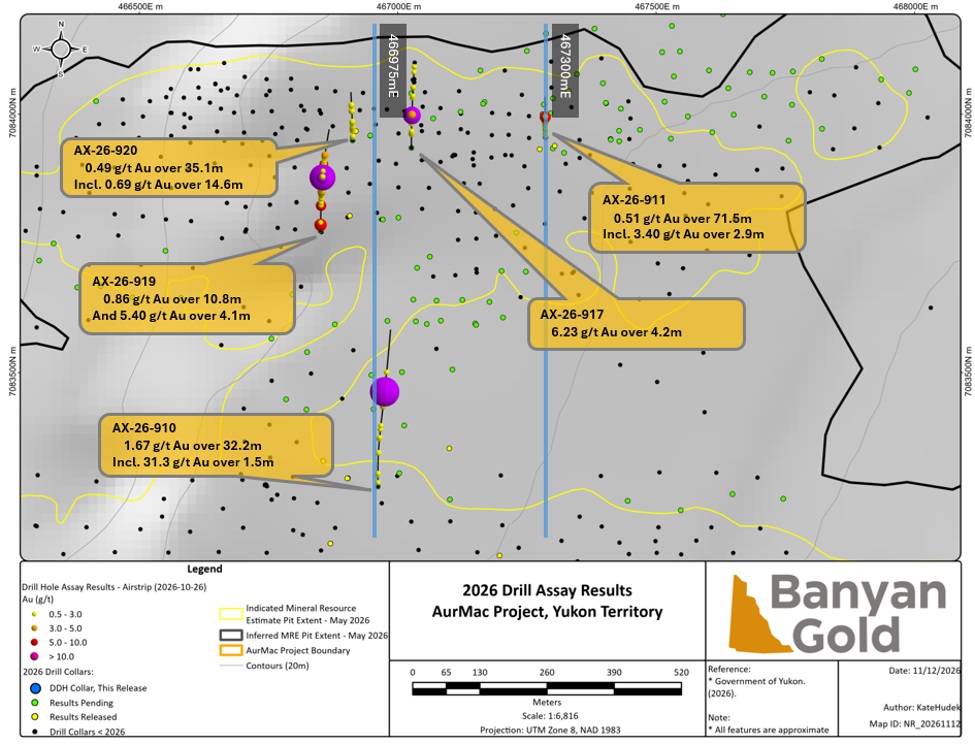
Mineralization at Airstrip is predominantly hosted in calcareous metasedimentary rocks that readily undergo calc-silicate alteration and sulphide replacement mineralization (Figure 5). Calcareous metasedimentary rocks overlie quartzites. Domains Cal 1 and Cal 2 (calcareous metasedimentary rocks) are the primary host for gold mineralization at Airstrip, with extensional quartz veins hosted in the quartzite ("QTZT"). A notable zone of mineralization has been intersected in the footwall of Airstrip, with high-grade mineralization (Figure 6) identified in extensional quartz veins hosted in quartzite stratigraphically below the main Airstrip deposit (Figure 2). Potential for footwall domains in the Airstrip area has been identified in previous drilling, with additional testing planned for the 2027 drill program.
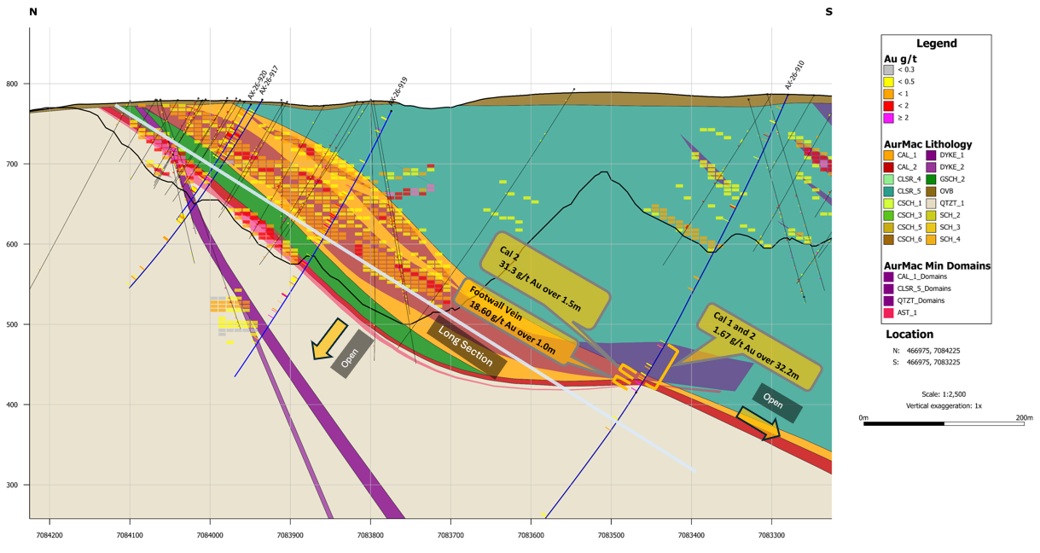
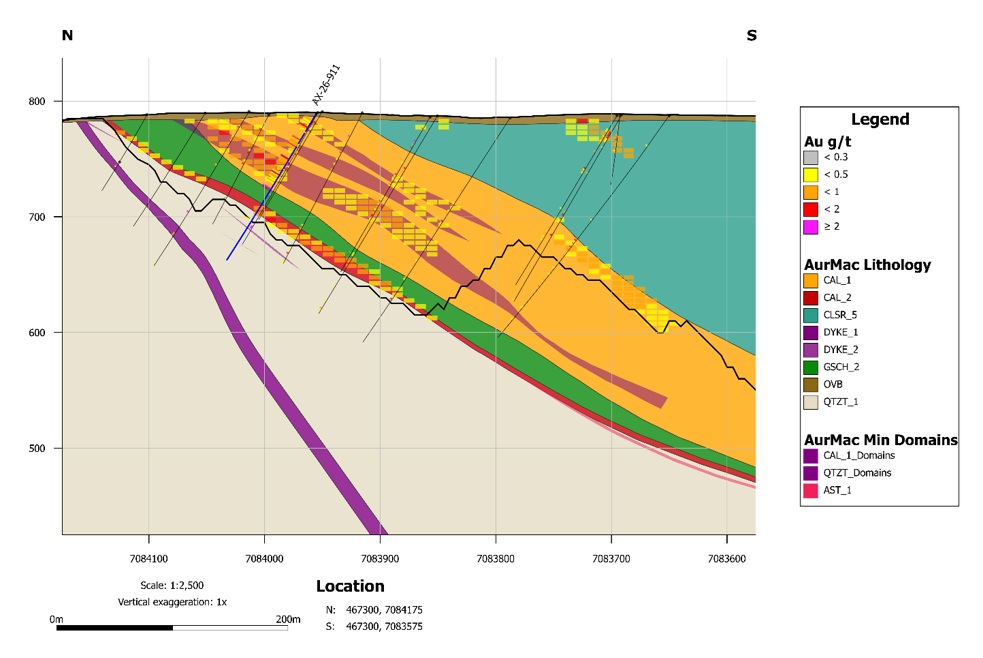
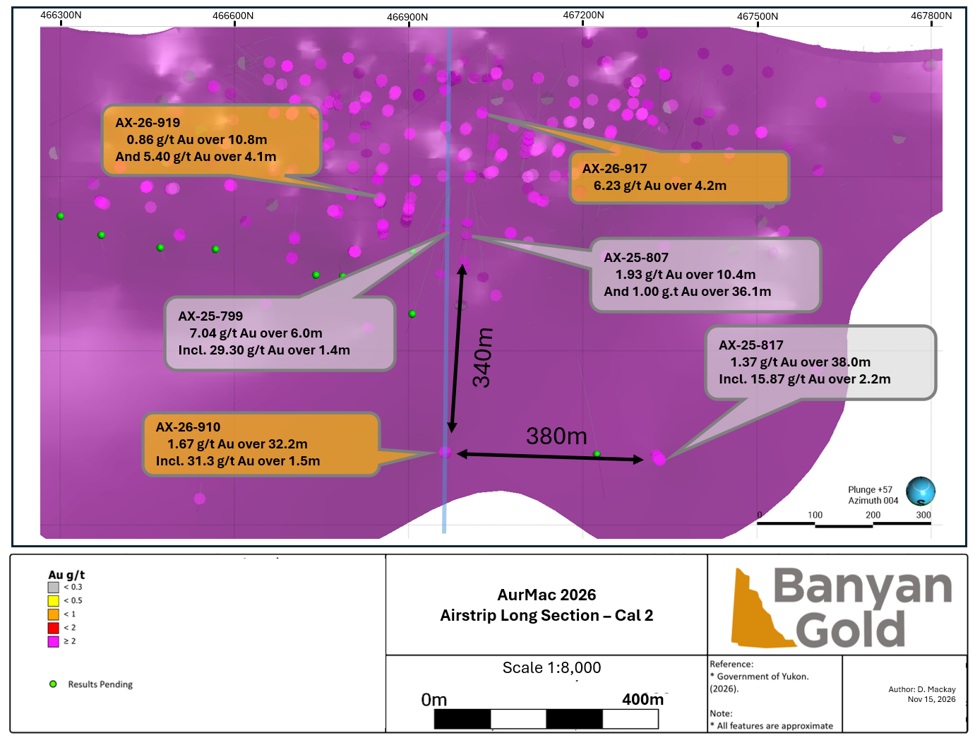
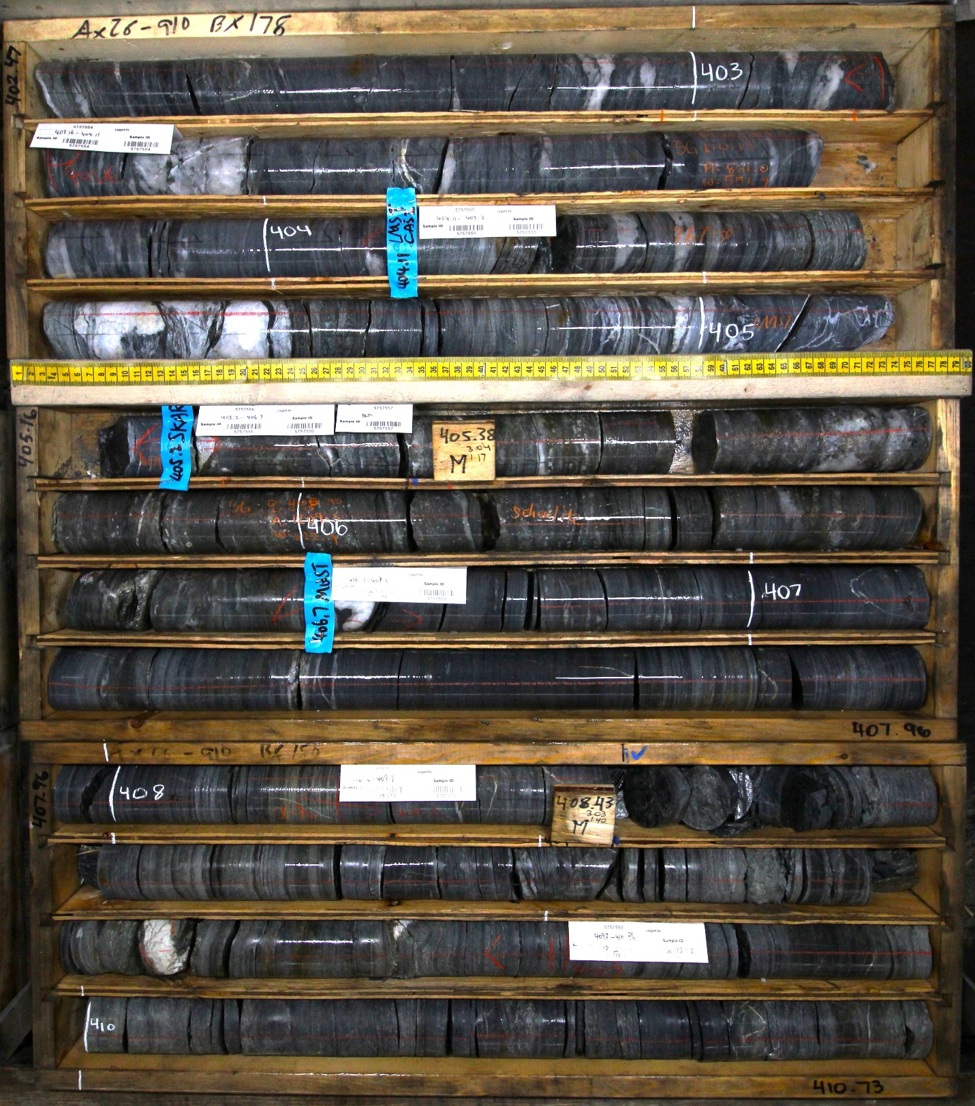
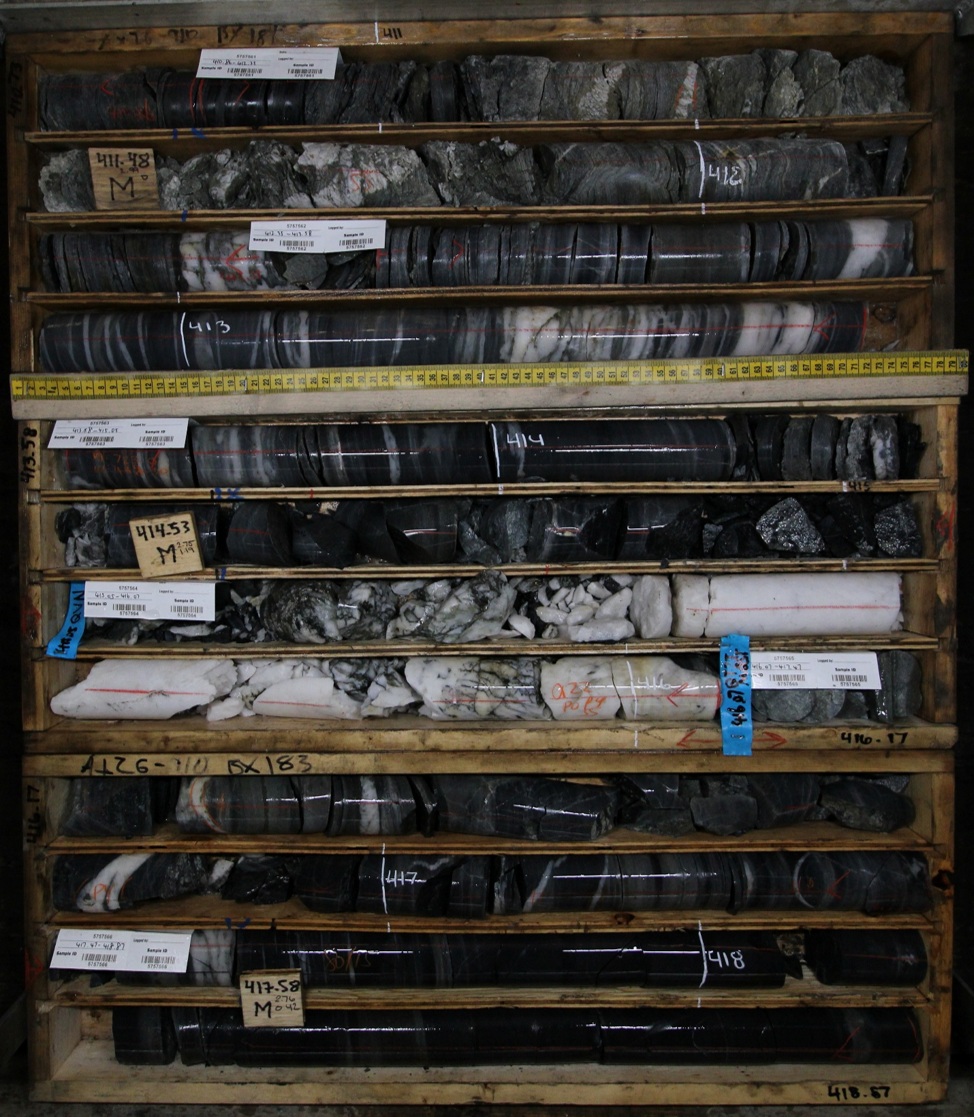
Table 1: Intervals from Airstrip
| HOLE NUMBER | Depth From (m) | Depth To (m) | Au Interval (m) | Au Grade (g/t) |
AX-26-910 | 57.3 | 58.0 | 0.7 | 1.13 |
and | 155.4 | 156.8 | 1.4 | 1.30 |
and | 214.8 | 221.7 | 6.9 | 0.18 |
and | 254.4 | 272.0 | 17.6 | 0.16 |
and | 350.5 | 355.6 | 5.1 | 0.60 |
and | 374.5 | 406.7 | 32.2 | 1.67 |
including | 374.5 | 374.8 | 0.3 | 7.43 |
including | 405.2 | 406.7 | 1.5 | 31.30 |
and | 415.0 | 416.1 | 1.1 | 18.60 |
AX-26-911 | 7.4 | 78.9 | 71.5 | 0.51 |
including | 14.1 | 15.6 | 1.5 | 1.20 |
and including | 27.2 | 27.9 | 0.7 | 1.08 |
and including | 46.1 | 47.7 | 1.6 | 1.78 |
and including | 62.0 | 63.4 | 1.4 | 2.40 |
including | 63.0 | 63.4 | 0.4 | 4.20 |
and including | 76.0 | 78.9 | 2.9 | 3.40 |
including | 76.0 | 77.4 | 1.4 | 6.44 |
AX-26-917 | 49.5 | 62.5 | 13.0 | 0.55 |
including | 52.3 | 55.0 | 2.7 | 1.53 |
and | 88.9 | 90.3 | 1.4 | 1.23 |
and | 117.5 | 121.7 | 4.2 | 6.23 |
including | 118.1 | 121.7 | 3.6 | 6.86 |
including | 118.1 | 119.3 | 1.2 | 16.40 |
and | 176.4 | 184.8 | 8.4 | 0.50 |
and | 209.7 | 212.7 | 3.0 | 0.80 |
and | 257.8 | 275.5 | 17.7 | 0.14 |
AX-26-919 | 26.6 | 37.4 | 10.8 | 0.86 |
including | 26.6 | 27.4 | 0.8 | 9.63 |
and | 107.2 | 109.0 | 1.8 | 2.36 |
including | 107.2 | 107.7 | 0.5 | 7.32 |
and | 118.7 | 137.0 | 18.3 | 0.22 |
including | 134.7 | 135.6 | 0.9 | 1.43 |
and | 145.5 | 190.0 | 44.5 | 0.58 |
including | 148.0 | 173.5 | 25.5 | 0.70 |
including | 157.5 | 164.3 | 6.8 | 0.77 |
and including | 184.0 | 190.0 | 6.0 | 0.52 |
and | 215.6 | 219.7 | 4.1 | 5.40 |
including | 215.6 | 218.9 | 3.3 | 6.46 |
including | 215.6 | 217.2 | 1.6 | 12.30 |
including | 216.1 | 217.2 | 1.1 | 16.48 |
and | 239.0 | 248.9 | 9.9 | 0.37 |
and | 264.7 | 297.9 | 33.2 | 0.39 |
including | 264.7 | 266.7 | 2.0 | 3.31 |
including | 264.7 | 265.7 | 1.0 | 5.05 |
and including | 289.3 | 297.9 | 8.6 | 0.45 |
including | 297.2 | 297.9 | 0.7 | 3.35 |
AX-26-920 | 11.1 | 17.1 | 6.0 | 0.57 |
and | 36.9 | 72.0 | 35.1 | 0.49 |
including | 36.9 | 51.5 | 14.6 | 0.69 |
and including | 71.4 | 72.0 | 0.6 | 1.35 |
and | 107.3 | 109.5 | 2.2 | 1.17 |
including | 108.1 | 109.5 | 1.4 | 1.46 |
and | 124.5 | 130.6 | 6.1 | 0.69 |
including | 129.6 | 130.6 | 1.0 | 1.46 |
Note: Calculated true widths are approximate and vary by drillhole; see Table 2.
Table 2: Collars for diamond drillholes in this release
Hole ID | Easting (m) | Northing (m) | Elevation (m) | Length (m) | Azimuth | Dip | Calc. True Width (%) |
AX-26-910 | 466961 | 7083280 | 786 | 611.1 | 0 | -66 | 95 |
AX-26-911 | 467286 | 7083955 | 790 | 149.4 | 0 | -60 | 95 |
AX-26-917 | 467026 | 7083935 | 780 | 288.1 | 0 | -60 | 95 |
AX-26-919 | 466851 | 7083774 | 766 | 385.6 | 0 | -64 | 90 |
AX-26-920 | 466913 | 7083949 | 774 | 170.7 | 0 | -60 | 95 |
Analytical Method and Quality Assurance/Quality Control Measures
The reported work was completed using industry standard procedures and a quality assurance/quality control ("QA/QC") program consisting of the insertion of certified reference materials, field duplicates and coarse blanks into the sample stream and utilizing certified independent analytical laboratories for all assays.
The Qualified Person reviewed the available QA/QC data and identified no material issues.
Certified reference materials, field duplicates and coarse blanks represented approximately 10% of samples submitted during the 2026 drilling program. Results were monitored as analytical data became available and were within the accuracy and precision thresholds established for the program.
Banyan personnel systematically logged and photographed all diamond drill core. HTW-and NTW-diameter core was split at Banyan's core-processing facilities. One half was returned to the core box and the other was sealed in a poly bag with one part of a three-part sample tag. Banyan personnel or a dedicated expediter delivered samples to the Bureau Veritas ("BV") preparation laboratory in Whitehorse or to AGAT Laboratories' Geochemical Mining Division in Calgary ("AGAT"). Samples prepared by BV were shipped to its analytical laboratory in Vancouver, British Columbia. AGAT samples were prepared, pulverized and analyzed in Calgary, Alberta, or Thunder Bay, Ontario.
BV analyzed samples using four-acid digestion and either its MA-200 ICP-ES 45-element package or MA-250 ICP-ES/MS 59-element package, together with FA-450 50 g fire assay with an AAS finish for gold. Samples returning more than 10 g/t Au were reanalyzed by FA-550 fire assay with a gravimetric finish. High-grade samples containing documented visible gold were also analyzed by FS-652 metallic-screen fire assay. Silver overlimits were analyzed using MA-370, FA-550 or FA-501, as applicable. Bureau Veritas is accredited to ISO/IEC 17025:2017 under SCC File No. 15895.
AGAT analyzed samples using four-acid digestion and its 201-071 ICP-OES/ICP-MS 48-element package, together with 201-551 50 g fire assay with an AAS finish for gold. Samples returning more than 10 g/t Au were reanalyzed by 202-551 fire assay with a gravimetric finish. High-grade samples containin