

from Churchill Resources Inc. (CVE:CRI)
Churchill Intersects 19.23% Antimony over 1.40 Metres at Frost Cove North and at PC Pond Expands Vein Swarm and Intersects New Prospect Grading 0.78% Copper with 61.2 g/t Silver over 6.22 Metres on the Black Raven Project, Central Newfoundland
TORONTO, ON / ACCESS Newswire / August 28, 2026 / Churchill Resources Inc. ("Churchill" or the "Company") (TSXV:CRI.V) is pleased to report final assay results from its Spring 2026 program of core drilling and trenching at the Black Raven Project. The work was focused on both Pomley Cove Pond ("PC Pond") where the Company's recent discovery of a potentially extensive polymetallic vein swarm associated with rhyolitic volcanic rocks has been significantly expanded, and a second round of delineation drilling of the Frost Cove North antimony-gold prospect.
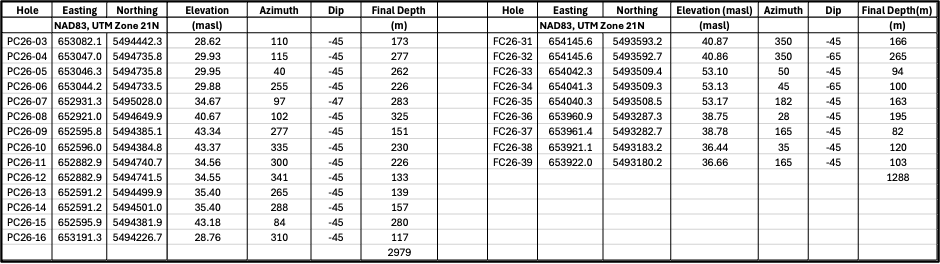
The Spring program included the drilling of 23 drillholes, with a cumulative depth of 4,267m (Table 5), along with extensive trenching, channel, and soil sampling. Fourteen holes, totalling 2,979m depth, were dedicated to expanding the PC Pond prospect (Fig. 1, Tables 1-3), and the remaining nine holes (cumulative of 1288m) to delineation work at Frost Cove North (Fig. 2, Table 4); all results reported here. Most holes were surveyed by televiewer to assist with Leapfrog modelling of the PC Pond complex and refining the Frost Cove North geological model.
At PC Pond, the 2026 drilling both expanded the Au-Ag-Mo vein swarm and discovered a broad succession of associated felsic extrusive rocks first intersected in hole PC25-02, within the down-dropped portion of a regional graben structure, that appears to be at, or near, the locus of the Black Raven mineralization and quartz-feldspar porphyry dykes. A delineation drilling program for the Fall on the Peninsula Vein Swarm ("PVS") is being planned, to target the strike extents of, and drill the first deep holes into, the mineralized structure.
At Frost Cove North the highlight was drillhole FC26-34, targeted on a gap in our 2025 delineation drilling, which intersected a project best 19.23% Sb and 0.73 gpt Au over 1.40m, which included an interval of 56.20% Sb over 0.47m. The majority of the other holes intersected polymetallic Au-Ag-Sb-As-Zn mineralization.
Churchill interprets these results as indicating that the Black Raven Property potentially contains a large-scale mineralized system in which critical and precious metals occur in association with felsic intrusive (dyke) and extrusive (volcanic flow and breccia) rocks, all centred about PC Pond. The Company is excited by our exploration results to date and doubled the 2025 soil sampling this Spring to expand coverage at the mineralized core of the project.
PC Pond Gold, Silver, Molybdenum Spring 2026 Highlights Include:
Mineralized Zones within Interpreted Felsic Volcanic Complex (Fig. 1, Tables 1-3, 5)
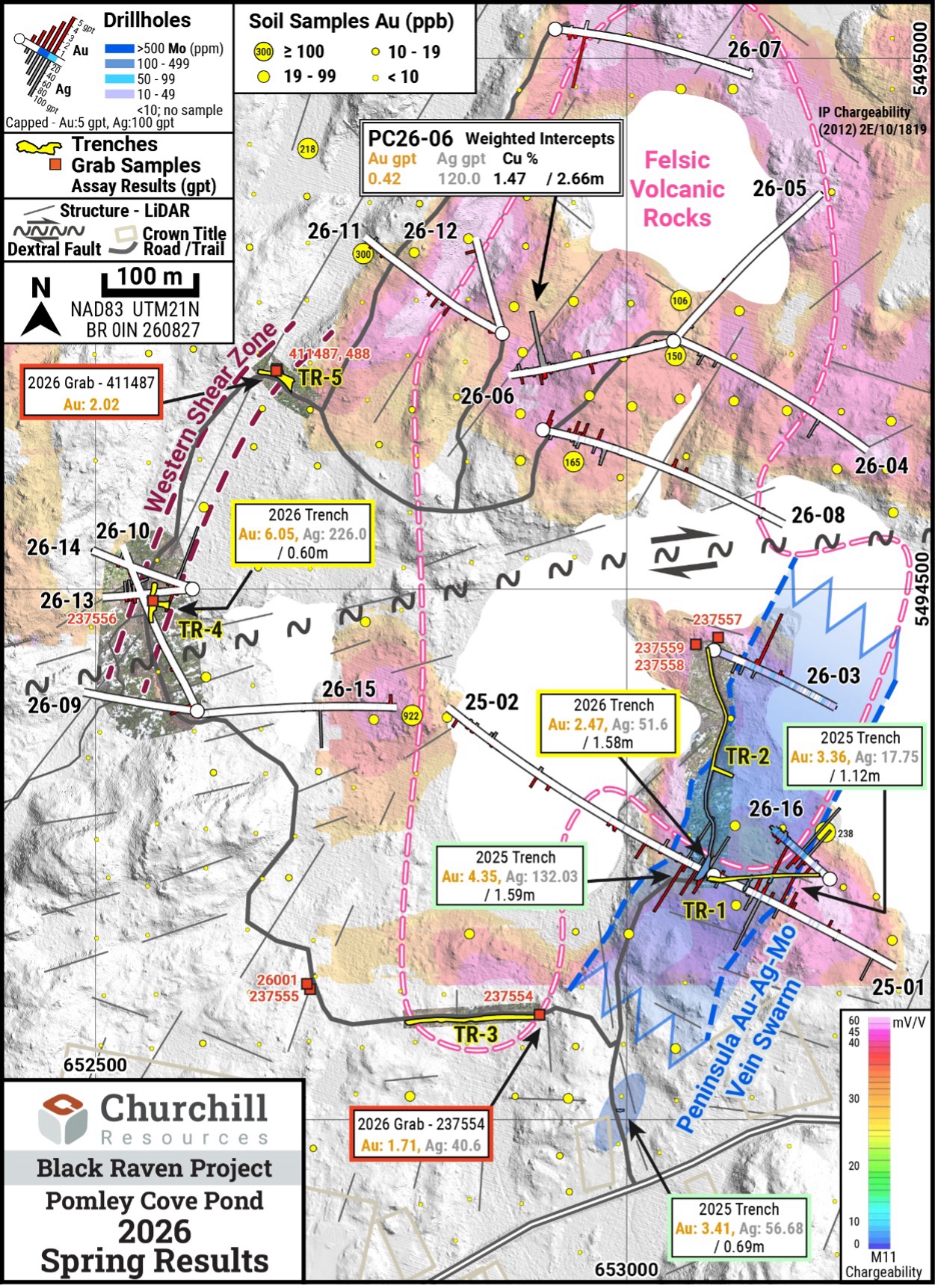
2026 PC Pond drilling intersected a newly recognized felsic volcanic complex that correlates with historical IP ("induced polarization") chargeability and arsenic-in-soil anomalies, due to its elevated disseminated arsenopyrite contents. Numerous mineralized shear zones/quartz veins were intersected within, and adjacent to, the dome per Fig 1. The Peninsula Vein Swarm and Western Shear Zone are interpreted to be primary fault systems integral to the volcanic complex.Expanded gold-silver-molybdenum vein system at the Peninsula Vein Swarm ("PVS")
The original vein swarm discovery made in November 2025 has now been expanded to an interpreted strike length of at least 200m along strike to the north, from the results of channels in Trench TRPC-02 along the length of the peninsula, and from drillhole PC26-03 at its north end. Systematic channels in the trench exposed numerous sulphide-rich shear zones within both the mafic country rock as well as the brecciated felsic dome rocks carrying 1-5% disseminated arsenopyrite. There is a distinct molybdenum enrichment, as well as potassic and magnetite alteration evident in the centre of the PVS within numerous veins over the core ~100m width in plan-view of the structural corridor. The PVS is interpreted to potentially extend hundreds of metres further to both the north and south and is open at depth where more ductile rocks may have allowed for larger mineralizing systems to form. Elsewhere in the felsic dome complex the alteration, volcanic textures, and isolated mineralized structures suggest a more distal setting.
Highlights include:Surface (Tables 1 and 2): Intercepts include the following (weighted averages):
2.47 g/t Au, 78.8 g/t Ag over 1.58 m (TRPC02 - channel 20)
1.21 g/t Au, 51.3 g/t Ag, 918 ppm Mo over 0.57m (TRPC02 - channel 15)
Drilling (Table 3): Hole PC26-03 was targeted to intersect the inferred strike of the PVS approximately 200m to the north of the discoveries and it intersected a portion of the overall structure. Hole PC26-16 targeted to cross the structure ~100m south of Hole PC26-03, intersected encouraging stockworkveining and visible molybdenite mineralization further raising confidence in the PVS being an important fluid conduit. The planned Fall 2026 drill program will commence with extending holes PC26-03 and PC26-16 across the entirety of the PVS, followed by systematic delineation work along strike.
Intercepts in PC26-03 include the following (weighted averages):
3.68 g/t Au, 10.7 g/t Ag over 0.67m.
Numerous discrete vein and breccia samples returned elevated Au, Ag, and Mo assays throughout the 173m intersection of rhyolite.
Intercepts in PC26-16 include the following (weighted averages):
Numerous veins returned elevated Au, Ag, and Mo assays.
Individual samples assayed high values of 1.67 gpt Au, 135 gpt Ag, 1.10% Pb, 2.28% Zn, and 787 ppm Mo.
The best molybdenum intersection on the property was intersected near surface, 1.09% Mo over 0.19m at 8.36m down hole (-45 degree dip).
New Copper-Silver- Gold Prospect - Hole PC26-06 Intersection
⪠Drillhole PC26-06 was designed to test a strong arsenic-copper-gold-silver soil anomaly with coincident IP chargeability response |
⪠Strong chalcopyrite mineralization was intersected in a broad felsic breccia grading 0.78% Cu, 61.2 gpt Ag, and 0.23 gpt Au over 6.22m |
⪠Higher grading material included within the broader interval yielded 1.47% Cu,120.0 gpt Ag, and 0.42 gpt Au over 2.66m. |
⪠The planned Fall 2026 program will investigate this copper-silver-gold prospect with trenching and drilling. |
Figure 1 - Pomley Cove Pond Surface Sampling and Drilling Highlights to 25-08-26
Frost Cove North Antimony-Gold Prospect Spring 2026 Highlights Include:
⪠The 2026 program was designed to intersect the Antimony and Gold-Silver-bearing shear zones along the northern 500m of the host structure at low angles to assess the continuity of mineralization, and identify the location of cross structures. |
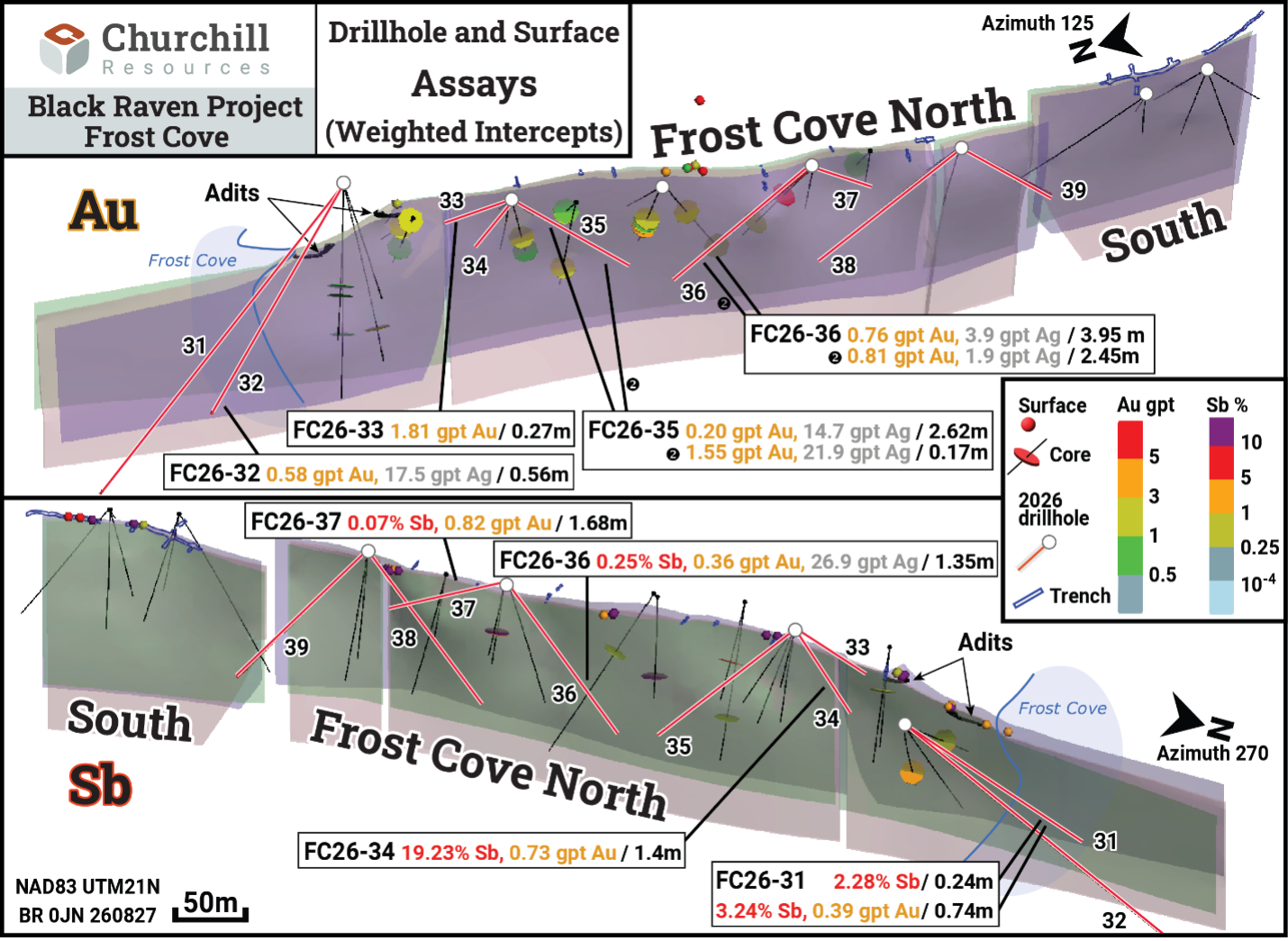
⪠Holes FC26-31 and 32 were designed to test the northern strike extent of the historical mine and were successful with hole FC26-31 intersecting two antimony zones with the lower interval grading 3.24% Sb and 0.39gpt Au over 0.74m. Hole FC26-32 drilled at a steeper dip along the same azimuth intersected gold-silver-zinc mineralization per Figure 2 and Table 4. |
⪠Hole FC26-34 was targeted on a gap in our 2025 delineation, ~50m north of the historical shaft, and intersected a project-best 19.23% Sb and 0.73 gpt Au over 1.40m. |
⪠Holes FC26-35 to 39 did not intersect the antimony shear due to microgranite intrusions along the host quartz-feldspar dyke which appear to have disrupted or redirected the antimony-bearing shear on the east side of the dyke. |
⪠Holes FC26-35 to FC26-37 did intersect the Au-Ag shear zone which carried low antimony grades as well. |
⪠Geological and mineralogical information from holes FC26-31 to 39 will allow for a more robust structural-geological Leapfrog model of Frost Cove North |
⪠Detailed mapping is planned over Frost Cove South to better understand the complex structural setting and thereby direct follow-up trenching where massive stibnite mineralization has been found and traced for ~80m on surface. |
Note that all drill core and channel sample lengths and composite intervals provided in the tables, figures and text in this news release are measured core/channel lengths and do not represent true thicknesses of the units sampled.
Additional Black Raven Technical Activities
⪠Soil grid expanded to the west, south, and east - ~2600 soil samples to report |
⪠Property-scale and detailed mapping/prospecting partially complete |
⪠Leapfrog modelling of the PC Pond complex has commenced along with updating the Frost Cove North geological model |
Figure 2- Frost Cove North Drilling Results to 25-08-2026
About the Black Raven Gold-Silver-Antimony Project
The Black Raven Project is a polymetallic exploration asset in Central Newfoundland characterized by high-tenor antimony mineralization and gold-silver-lead-zinc-molybdenum systems. Churchill's primary objective is to evaluate the projects' potential to host small-footprint, high-grade underground mine(s).
The project encompasses the past-producing Frost Cove Antimony Mine and Stewart Gold Mine. While these sites operated intermittently at the turn of the last century, Churchill is the first to apply modern systematic exploration techniques over the entire property to understand these and other occurrences. Black Raven is located approximately 60km northwest of Gander, Newfoundland, and approximately 100km north of the dormant Beaver Brook Antimony Mine. The project benefits from excellent infrastructure, including roads, power, proximity to tidewater and ports, and locally integrated operational and technical teams.
Antimony is recognized as a vital critical mineral, essential for Canada's national and economic security. It is a key component in military applications, flame retardants, alloy strengthening in batteries, and emerging energy storage technologies. Securing a reliable domestic supply chain for antimony is paramount for critical mineral supply chains, bolstering both economic resilience and strategic independence. Currently, North America lacks sources of high-grade, primary antimony supply, making a potential domestic source at Black Raven critically important.
About Churchill Resources
Churchill Resources Inc. is a Canadian exploration company focused on exploration and evaluation of strategic and critical metals in Canada, principally at its prospective Black Raven, Golden Baie, Taylor Brook and Florence Lake properties in Newfoundland & Labrador. The Churchill management team and board have decades of combined experience in mineral exploration and in the establishment of successful publicly listed mining companies, both in Canada and around the world. Churchill's Newfoundland and Labrador projects benefit from the province's large and diversified minerals industry, which includes tier-one class mines and processing facilities, and a well-developed mineral exploration sector with locally based drilling and geological expertise.
Qualified Person
The technical and scientific information in this news release has been reviewed and approved by Dr. Derek H.C Wilton, P.Geo., FGC, who is a "qualified person" as defined under National Instrument 43-101 - Standards of Disclosure for Mineral Projects ("NI 43-101"). Dr. Wilton is a former professor of Economic Geology at Memorial University in St. John's and is independent of the Company for the purposes of NI 43-101. Dr. Derek Wilton has examined all of the grab and channel sampling sites and all drill holes reported herein. Dr. Wilton is included on all assay reports from the laboratories and has total access to the Company's cloud-based central database for data validation purposes.
Sampling Program
Antimony, gold, silver, lead, zinc, copper and molybdenum samples were identified and collected by Company geologists from drill cores, channel samples, and grab samples. Core samples were halved by saw at the Company's core facility near Boyd's Cove. Trench and grab samples were entirely submitted. Note that grab samples are selective in nature and therefore may not represent the true grade of the outcrop sampled.
All samples were labelled and securely bound and delivered to the laboratory of Activation Laboratories Ltd. ("Actlabs") in Fredericton, New Brunswick, for crushing and pulverizing. Actlabs is ISO/IEC 17025 (Lab 266) certified, Health Canada Licensed, FDA inspected and registered, and independent of Churchill. Blanks and known standards for antimony and gold were included by Company geologists both regularly every 20 samples, and also immediately following all high-grade samples. Splits were couriered to Actlabs, Ancaster and analysed by using Actlabs Method Code 1E3 Aqua Regia ICPOES for the multi element and Code 1A2 Fire Assay AA for gold. Over-limit antimony samples were analysed using Actlabs Method Code FUS-Na2O2 Special Fusion Method. Actlabs also has standard QA/QC protocols which are reported with each assay batch.
Significant-interval composites in Tables 2, 3 and 4 were selected and weighted averages calculated without upper cut-offs and below-detection limit samples, if included in a composite, were cut to 50% of the value.
Table 1 - PC Pond 2026 Grab Sample Results to 25-08-26

Table 2 - PC Pond 2026 Channel Sample Mineralization Results to 25-08-26
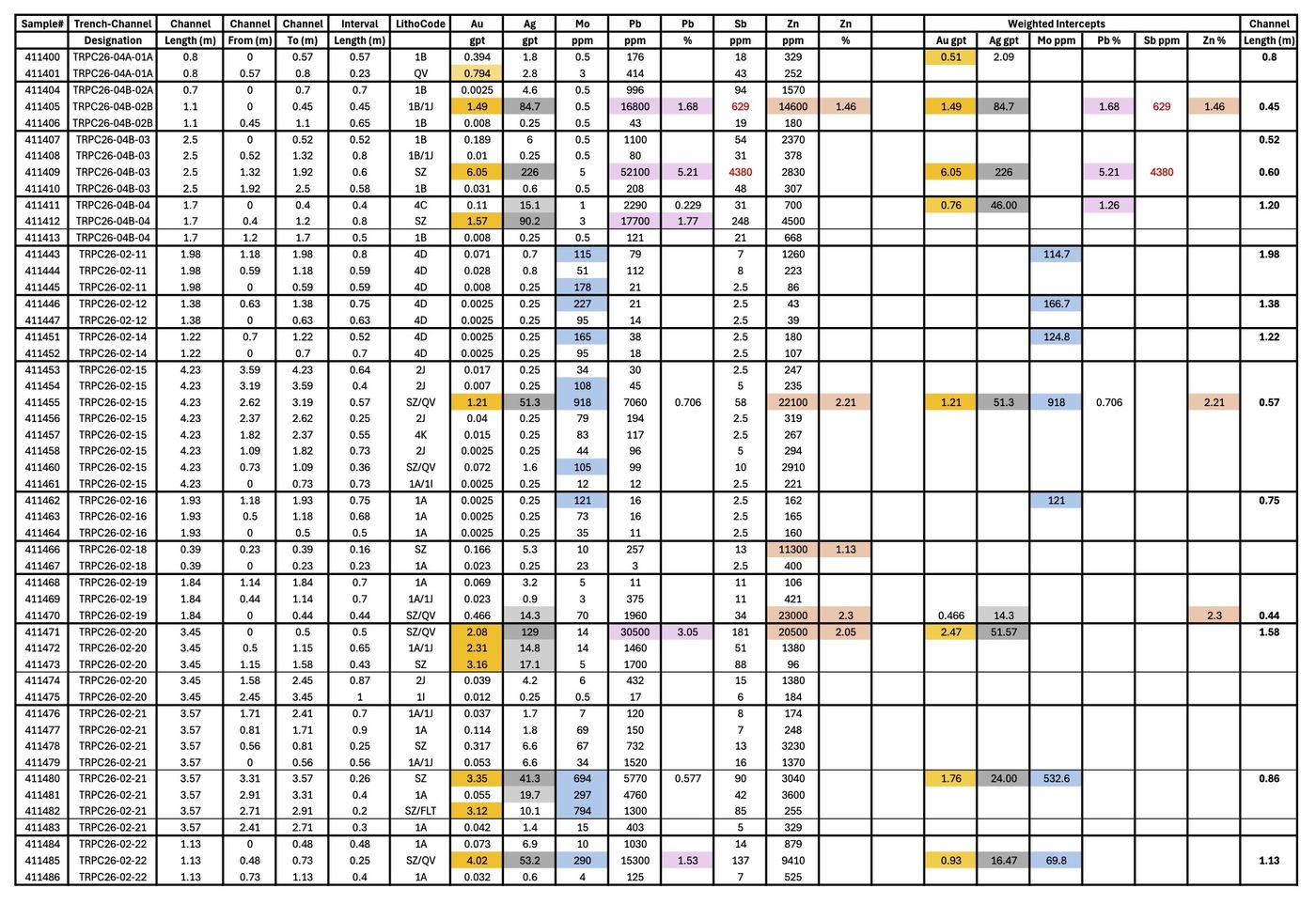
Table 3 - PC Pond Mineralized Drill Core Mineralized Sample Results to 25-08-2026
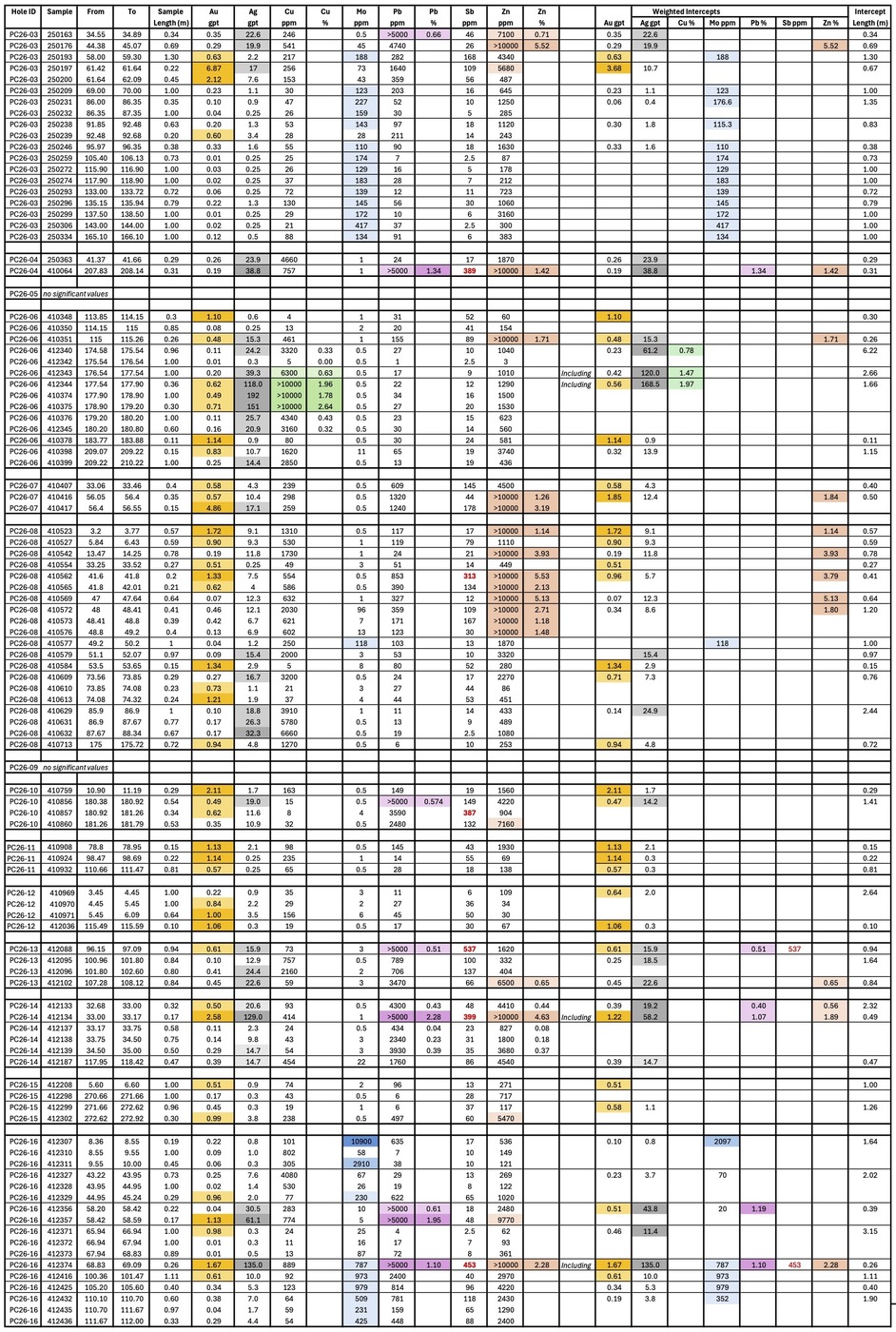
Table 4 - Frost Cove North Drill Core Mineralized Sample Results to 25-08-2026
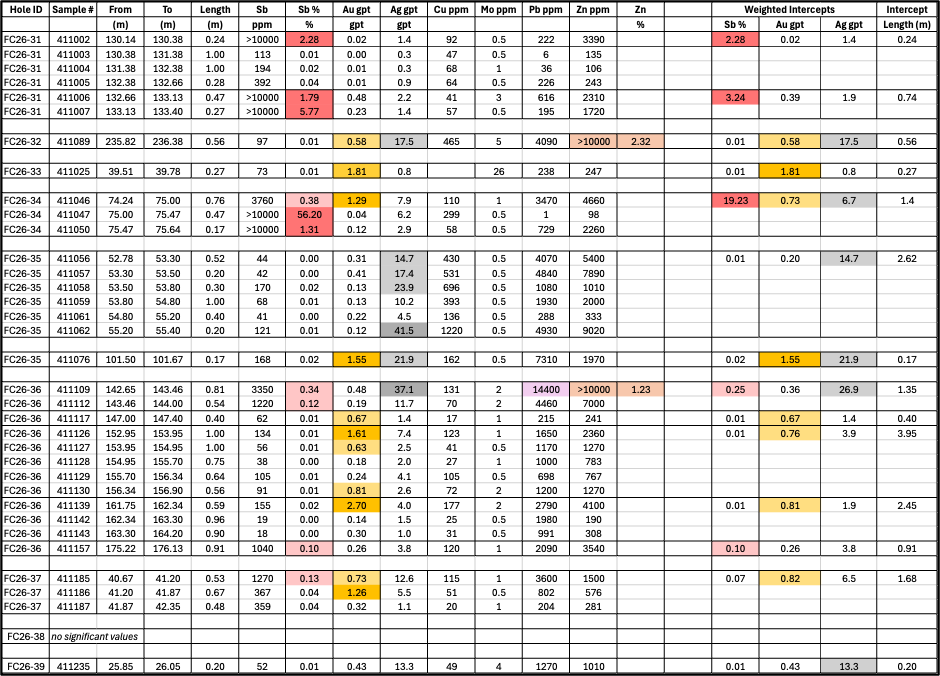
Table 5 - 2026 Black Raven Drillhole Collar Information (NAD83, UTM Zone 21N)
Further Information
For further information regarding Churchill, please contact:
Churchill Resources Inc.
Tasheel Jeerh, Chief Executive Officer
Tel. 403.988.7663 (m)
Email: tjeerh@churchillresources.com
Paul Sobie, President
Tel. 416.365.0930 (o) 647.988.0930 (m)
Email: psobie@churchillresources.com
FORWARD-LOOKING STATEMENTS
This news release contains certain forward-looking statements, including, but not limited to, statements about Churchill's objectives, goals and exploration activities proposed to be conducted on its properties; future growth potential of Churchill, including whether any proposed exploration programs at any of its properties will be successful; exploration results; and future exploration plans and costs. Wherever possible, words such as "may", "will", "should", "could", "expect", "plan", "intend", "anticipate", "believe", "estimate", "predict" or "potential" or the negative or other variations of these words, or similar words or phrases, have been used to identify these forward-looking statements. In particular, this release contains forward-looking information relating to, among other things, the Company's goals and objectives, and future exploration work to be conducted on the Company's Black Raven Gold-Antimony Property. These statements reflect management's current beliefs and are based on information currently available to management as at the date hereof.
Forward-looking statements involve significant risk, uncertainties and assumptions. Many factors could cause actual results, performance or achievements to differ materially from the results discussed or implied in the forward-looking statements. These factors should be considered carefully and readers should not place undue reliance on the forward-looking statements. Such factors, among other things, include: exploration results on the Black Raven Antimony Property; the expected benefits to Churchill relating to the exploration proposed to be conducted on its properties; receipt of all regulatory approvals in connection with the transaction contemplated herein; failure to identify any additional mineral resources or significant mineralization; the preliminary nature of metallurgical test results; uncertainties relating to the availability and costs of financing needed in the future, including to fund any exploration programs on the Churchill's properties, if required; fluctuations in general macroeconomic conditions; fluctuations in securities markets; fluctuations in spot and forward prices of gold, silver, base metals or certain other commodities; change in national and local government, legislation, taxation, controls, regulations and political or economic developments; risks and hazards associated with the business of mineral exploration, development and mining (including environmental hazards, industrial accidents, unusual or unexpected formations pressures, cave-ins and flooding); inability to obtain adequate insurance to cover risks and hazards; the presence of laws and regulations that may impose restrictions on mining and mineral exploration; employee relations; relationships with and claims by local communities and indigenous populations; availability of increasing costs associated with mining inputs and labour; the speculative nature of mineral exploration and development (including the risks of obtaining necessary licenses, permits and approvals from government authorities); the unlikelihood that properties that are explored are ultimately developed into producing mines; geological factors; actual results of current and future exploration; changes in project parameters as plans continue to be evaluated; soil sampling results being preliminary in nature and are not conclusive evidence of the likelihood of a mineral deposit; and title to properties. Although the forward-looking statements contained in this news release are based upon what management believes to be reasonable assumptions, the Churchill cannot assure readers that actual results will be consistent with these forward-looking statements. These forward-looking statements are made as of the date of this news release, and the Churchill assumes no obligation to update or revise them to reflect new events or circumstances, except as required by law. Neither the TSXV nor its Regulation Services Provider (as that term is defined in the policies of the TSXV) accepts responsibility for the adequacy or accuracy of this release.
SOURCE: Churchill Resources Inc.
View the original press release on ACCESS Newswire