

from Nano One Materials Corp. (NASDAQ:NNOMF)
2026 Letter to Nano One Stakeholders
Nano One® Materials Corp. ("Nano One" or the "Company") (TSX:NANO)(OTCQB:NNOMF)(Frankfurt:LBMB), a process technology company specializing in lithium-ion battery cathode active materials, provides a message to our stakeholders.
To view this release in its original stylized PDF Clicks Here
VANCOUVER, BC / ACCESS Newswire / June 3, 2026 / Opening Remarks from Board Chair
To our Shareholders, Customers, Commercial and Government Partners, and Colleagues,
Before Alex Holmes addresses you directly, I would like to offer a few remarks on behalf of the Board of Directors.
The Board would like to thank Dan Blondal for more than a decade of leadership in advancing the Company's technology, strengthening its team, and building its commercial capabilities. His contributions have helped position Nano One for the opportunities ahead, and we appreciate his continued support through the remainder of 2026 to help ensure a smooth transition.
We are excited to have a new CEO effective June 12 leading the Company through this important next stage of development and commercialization. It is especially meaningful that Alex comes from within Nano One's existing senior leadership team, reflecting the strength and depth of the management group that has been built. Alex brings deep expertise in the areas of strategy, corporate and commercial development, and financing-capabilities that are essential to the Company's next stage of growth and development. The Board has full confidence in Alex and the senior leadership team to lead Nano One into its next chapter, one defined by commercial execution, operational and financial discipline, and the creation of longâterm shareholder value. Over the past several years with Nano One, Alex has helped build the industrial capability that now makes commercialization possible.
The Company's strategy to date has focused on developing proprietary processing technology for the production of lithium iron phosphate (or lithium ferro phosphate or "LFP") cathode active materials used in lithium-ion batteries across a broad and growing range of markets, including defence, energy storage systems-from grid infrastructure to AI data centres-and electric vehicles. The strategy remains sound, and market dynamics for these materials have increasingly moved in Nano One's favour in recent years. The Board fully supports Alex and the senior leadership team as they advance Nano One through commercialization and into its next stage of growth and development.
- Anthony Tse
Independent Non-Executive Chairman, Nano One Materials Corp.
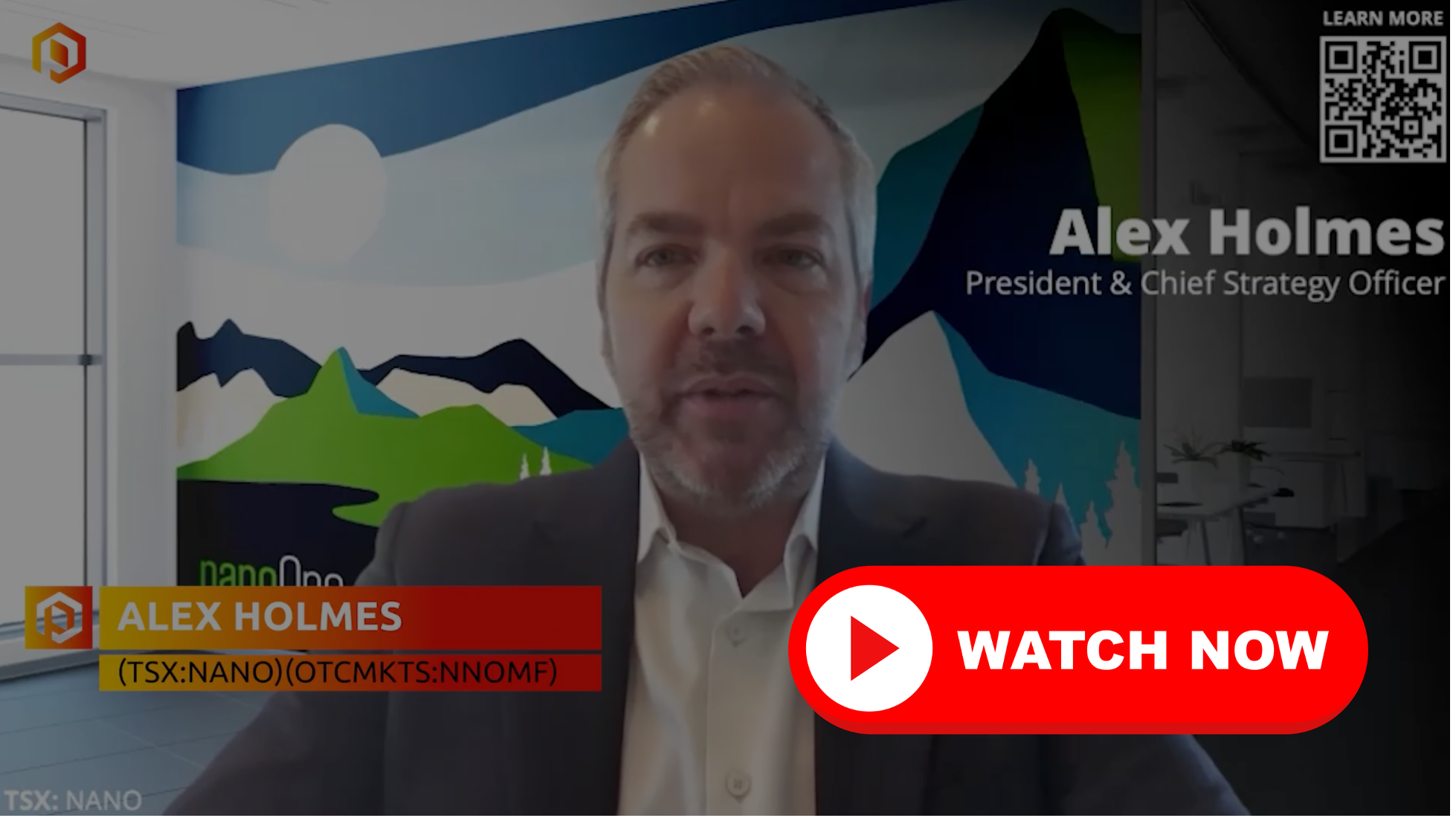
A Letter from Nano One's Incoming CEO
To our Shareholders, Customers, Commercial and Government Partners, and Colleagues,
I am writing as I prepare to take on the role of CEO at Nano One. Before I share where we are going, I want to be honest about where we have been-because credibility is earned in that order.
I am not new to this company. I joined as Chief Operating Officer in 2021 and was able to bring focus to the industrial side of an organization whose science had demonstrated it was worthy of scale-up. My first four years here were spent on the work that makes this letter possible: building out the operating team, the manufacturing skill set, and the industrial discipline needed to transform a breakthrough technology into a scalable business. That work led directly to the 2022 acquisition of our Candiac, Québec facility-giving Nano One its own pilot and demonstration capability instead of relying on third parties to scale.
I bring to this role a perspective shaped from the inside but also informed by a view to the broader ecosystem, together with a team that knows the technology and the industry deeply. I take on the role with clear eyes about the gap between where we are and where we need to be. I want to outline how we close it.
With Gratitude to Our Founder
Before I go further, I want to acknowledge Dan Blondal, who founded Nano One in 2011 and has led it as CEO and Director ever since.
The conviction that the world would need a fundamentally better way to make cathode materials and the early decision to invest in LFP at a moment when most industry participants in the Western world had not learned to fully appreciate the technology and chemistry was right. With a portfolio of more than fifty patents that protect our process innovations, and the leadership of a team that worked diligently to get us here-all of it traces back to his vision and to fifteen years of work building this from a concept into a company that strategic partners, governments, and the global battery supply chain know and respect.
Dan built a company with a solid foundation to be a leading battery materials player; the next chapter is about scaling it into commercial reality. I am deeply grateful to him, and stakeholders should be too.
Where We Stand
Nano One was founded in 2011 with a vision that has only grown stronger: the world would need cleaner, lowerâcost, more secure cathode materials, and the way to make them would have to be reinvented from the ground up. We filed our first patents in 2013, were granted our first U.S. patent in 2015, and today our cathode production process is protected by more than fifty patents globally. The industry limitations that we have in Western markets, whether on supply chain maturity, cost, or ability to deal with by-products, meant that Nano One had to find an alternative but equally competitive way to make battery materials-and to make them locally-and I am confident Nano One can deliver it.
Our early decision to focus on LFP-a cathode formulation that was widely dismissed in the West-meant we saw the change coming before Western OEMs, cell manufacturers, and governments did. We also saw the fundamental risk of an entire supply chain concentrated in a single country, a risk that has been even more highlighted against the backdrop of the COVID pandemic and recent conflicts in the Middle East. That judgment has aged well. According to Bloomberg New Energy Finance's (BNEF) 2024 CAM market report[1] LFP is now projected to represent more than half of the lithiumâion cathode market, with most future growth expected outside of China. The question is no longer whether LFP matters-it is who, outside of China, can produce it at scale. Nano One has what we believe is one of the most mature LFP manufacturing technologies outside of China today-and we are not alone in that view.
In the last two years we have built an operating pilot line, validated lithium feedstock from Rio Tinto, and deepened our partnership with Sumitomo Metal Mining following their rigorous due diligence on our IP. I want to acknowledge directly that commercialization at scale is still ahead of us-and that the steps above are what make it reachable.
Our public target is initial commercial LFP supply agreements for defence and energy-storage applications by the end of 2026, with first deliveries and meaningful sales ramping through 2027 as our Candiac demonstration line scales toward commissioned capacity of approximately 800 tonnes per annum.
What We Are Building and Why
The battery sector in North America and Europe has been through a turbulent couple of years. More than a dozen highâprofile failures have been reported-companies that collectively raised billions and have since filed for bankruptcy, undergone restructuring, cancelled gigafactory plans, or wound down operations.
What is important is that Nano One is still here, and we are still operating and embarking on the next stage of scaling-up toward commercialization. When the initial wave of Western battery announcements was at its peak-the gigafactory plans, the cathode and anode buildouts, the funding rounds-the question we heard most often was whether Nano One had missed the boat. We did not believe we had, and we held our approach under real pressure. There were opportunities along the way to pursue projects and partnerships that did not align with our long-term plan. We did not pursue them.
The most telling signal of where we sit is who is still leaning in: strategic partners like Sumitomo Metal Mining, Rio Tinto, the Governments of Canada and the United States, allied jurisdictions, and battery supply chain partners that increasingly look to Nano One as a viable, and preferred, alternative to manufacture LFP cathode materials for the lithium-ion battery sector outside of China. That conviction was earned over fifteen years of technical work and it is the foundation we will continue to build on going forward.
On Past Missed Milestones
The historic milestones we set were based on the best information available at the time. I will acknowledge that the way we communicated about them, at times, leaned more toward the positive than the full picture warranted-and that is something the new operating discipline I describe later in this letter is designed to correct. The substance of why milestones moved, however, is more complex.
There has been-and still largely is-a lack of LFP cell manufacturing capacity outside of China. Many Western automotive OEMs' own cell sourcing and chemistry strategies were, and in many cases still are, in formation and evolution. Cell makers serving this market sector-our direct customers-were themselves working out where their LFP cell capacity would be located, who would qualify it, and against which specifications. Their customers-the OEMs and endâapplication owners-were simultaneously redesigning cell formats, energy density, and cost targets. Each change flowed upstream to us, requiring product tweaks, reformulations, and additional qualification cycles. In parallel, China continued to set the pace it had been building for more than a decade, pushing the global standards and material specification bar upward, thus compounding the effect.
We have set our goals more conservatively, we are communicating them more carefully, and we are reporting progress with greater discipline. To our valued shareholders: your desire to hear regular news is understandable, but I would ask you to recognize that in a headsâdown execution phase, no news can be good news. Quiet quarters mean the team is working, not stalled, not putting out empty promises that later disappoint.
The missed milestones of the past are evidence of a company doing genuinely hard work in a genuinely complex environment-and being trusted, despite the slips, by some of the most demanding partners and customers in the industry. That trust is the asset we build on.
The Partners That Have Joined Us
Sumitomo Metal Mining ("SMM") is one of Japan's largest critical minerals and cathode materials companies, with roughly US$11 billion in annual sales. After two years of development work, performance testing, economic modelling, and intellectual property review, they confirmed Nano One in September 2025 as a key technology partner and announced an expanded collaboration to pursue LFP production together. Companies of SMM's scale do not deepen partnerships lightly.
Rio Tinto is on track to grow its tierâone lithium assets to over 200,000 tonnes production per year of lithium carbonate equivalent by 2028. We have completed validation work on Rio Tinto lithium feedstock at multiple stages of sampling-meaning a future OneâPot™ licensee anywhere in the world will be able to deploy our technology with feedstock already validated and supplied by one of the most credible producers and suppliers in the world.
Lithium is only the start. We are also working with North American and European iron suppliers to ensure their material meets batteryâgrade quality requirements-a key advantage of our OneâPot process, and an area where China's conventional sulphateâbased production remains the stronghold. We are doing the same on phosphoric acid and other reagents.
Building a credible ex-China LFP supply chain is not just about our technology; it is about the entire upstream and supply-chain ecosystem-lithium, iron, phosphates, reagents-being sourced, qualified, and localized. Few others are doing that integration work at this level, but building a robust supply chain-one focused on resilience and sustainability-is a must. Our process is positioned to enable it, because it accepts a wider range of iron feedstocks than conventional approaches that dominate today.
Some shareholders have asked why we have not named certain partners. In this industry, the larger counterparty almost always controls disclosure. A defence prime supplier, a cell maker, or an OEM is balancing dozens of supplier and customer conversations across multiple chemistries, geographies, and timelines. They name a supplier when it serves their strategy or they are firmly ready to commit. Sumitomo and Rio Tinto were unnamed well before they were named.
Governments have listened, asked tough questions directly to us and about us to others-part of their vigorous due diligence process. They supported us with small amounts and larger ones when we asked. Governments are now engaged with us as we have earned their trust and now play a part in helping shape policy in Canada, the United States, and the European Union. We are grateful for the trusted and direct dialogue we have had to date and the potential funding support moving forward.
Strategic relationships also rarely move in a straight line. A partnership can be quiet publicly for a year and active again the next. When a named relationship goes quiet, the work is usually still underway-it is simply not at a stage where we have something disclosable to say.
Our Customers and Our Markets
Two markets anchor our nearâterm commercial focus. Defence-specifically contractors and prime suppliers serving NATO nations-leads our direct sales effort out of Candiac. The volumes, qualification timelines, and sourcing requirements line up with what our Candiac operation can supply. Energy storage systems (ESS) are on a parallel commercial track and the primary path to largeâvolume offtakes for future OneâPot LFP plants. ESS cell manufacturers are where the meaningful commercial volumes will come from over time. Their demand profile also matches the capital that governments and grid operators are now deploying into stationary storage-demand that is accelerating as AI data centres strain power grids and create new, around-the-clock storage needs.
Customer acceptance in the automotive sector is a longer arc. We have sampled and tested with several major OEMs and are in supply discussions with a number of them. They keep returning our calls-not because they are ready to place a firstâsource order with a North American newcomer, but because they need us in the picture. Automotive is among the most riskâaverse and technically demanding customer bases in the world. Firstâsource supply almost always comes from incumbents at established scale, with new entrants entering their supply chain as secondâsource, localâsource, or strategicâresilience suppliers. That is a meaningful role, and the realistic one for Nano One. Our mission requires changing the supply chain, which means finding collaborators who want to build with us, not buyers simply shopping for a finished product.
These markets do not move in lockstep, and we are not treating them as if they do. Defence leads across NATO nations. In North America, energy storage comes first, with electric vehicles to follow. In Europe, energy storage and electric vehicles advance together. That is the discipline behind the strategy-meeting each market on its own terms and building, region by region, the supply chain the world increasingly needs.
The Policy Tailwinds
For most of Nano One's time to date, the case for exâChina battery materials was something we made to governments-today, it is something governments are making to us.
National security, energy security, and economic security have collapsed into a single conversation, and battery materials sit squarely at the centre of it. The G7 Critical Minerals Action Plan, adopted at Kananaskis in June 2025, established a coordinated framework across the G7 to secure supply chains for the minerals and materials that underpin defence, clean energy, and advanced manufacturing. The followâon Critical Minerals Production Alliance, launched in Toronto in October 2025, brought twentyâsix new investments and partnerships across nine allied countries-accelerating an estimated C$6.4 billion in projects, explicitly tied to defence and energyâsecurity outcomes.
Allied governments are also actively designing a critical minerals buyers' club-a coordinated G7 demandâside mechanism to provide price stability and offtake certainty for nonâChina supply, so producers and processors outside China can compete on a level playing field against stateâsubsidized incumbents. This is the policy architecture our business model was designed to plug into.
Domestic industrial strategies across Canada, the United States, the European Union, Japan, and Korea are moving in parallel directions-production incentives, accelerated permitting, defenceâaligned procurement, and direct project capital. Nano One has been a recipient and a participant in the industrial execution following these new policies, including a C$12.3 million contribution from Natural Resources Canada announced in our most recent corporate update.
Policy alone does not build a company. But for one doing exactly the kind of work governments now say they need done, in exactly the geographies they need it done in, the alignment between our strategy and the global policy environment is the strongest it has ever been.
What Shareholders Should Expect
Our 2026 catalysts and goals remain our goals. The team is organized to deliver them, the capital is allocated to them, and we are committed to delivering against them. They are goals, not guarantees. Anyone who tells you a multiâyear industrial scaleâup is certain is not telling you the truth.
I would also ask shareholders to be precise with us in how they read those goals. As I mentioned earlier, our public target is initial commercial supply agreements in defence and energyâstorage applications by the end of 2026. A signed agreement is one milestone. First commercial deliveries are another. These milestones are sequenced, not simultaneous, and qualification cycles in defence and ESS-like those in automotive-can move quarter to quarter for reasons that have little to do with our execution. We are working toward both. The 2026 marker on the calendar is the first.
What I commit to is this: we will work to hit these goals, we will report meaningful progress when achieved, and if a milestone moves, you will hear the reason and the recovery path from us.
That is the standard I will be holding the Nano One team to. I only ask that you hold us to the same.
Closing
We have the technology. We have the partners. We have the operational facilities. We have the team. We have a market moving decisively toward our chemistry, in regions that need an alternative to a singleâcountry supply chain.
The next chapter is about narrowing the gap between what we say and what we deliver.
Now we deliver.
Sincerely,
Alex Holmes
Incoming Chief Executive Officer
Nano One Materials Corp.
###
About Nano One®
Nano One® Materials Corp. (Nano One) is a process technology company changing how cathode active materials (CAMs) are produced for lithium-ion batteries. Nano One's platform is built on a portfolio of patented processes, decades of manufacturing know-how and modular plant designs that enable scalable, cost-competitive and easier-to-permit CAM production with resilient supply chains. The technology eliminates wastewater and byproducts while enabling regionally sourced raw materials and reducing exposure to foreign supply chain volatility. Modular plants are designed with fewer steps to reduce capex, energy and environmental intensity and to accelerate deployment, manufacturing and licensing. Product development and process optimization are based at Nano One's Innovation Centre in Burnaby, British Columbia while piloting, demonstration and commercial production are based in Candiac, Québec, supported by a team with more than 15 years of commercial cathode manufacturing experience supplying global cell manufacturers. Strategic collaborations with global partners including Sumitomo Metal Mining, Rio Tinto and Worley support Nano One's Design-One-Build-Many growth strategy. Nano One has received funding support from the Governments of Canada, the United States, Québec and British Columbia.
For more information, please visit nanoOne.ca.
Company Contact:
info@nanoone.ca
+1 (604) 420-2041
Forward-Looking Information
This letter contains "forward-looking information" within the meaning of applicable Canadian securities legislation (collectively, "forward-looking statements"). Forward-looking statements are not statements of historical fact and are generally identified by words such as "anticipate," "believe," "expect," "intend," "plan," "target," "objective," "goal," "estimate," "forecast," "project," "potential," "continue," "may," "will," "would," "could," "should," and similar expressions.
Forward-looking statements in this letter include, but are not limited to, statements regarding: Nano One's commercialization strategy and objectives; the timing and achievement of commercial supply agreements; customer qualification activities and commercial adoption of the Company's technologies; anticipated production capacity, commissioning, scale-up and utilization of the Candiac facility; expected sales and revenue opportunities; growth in the markets for lithium iron phosphate ("LFP") cathode active materials; the development of battery supply chains outside China; the Company's relationships with strategic partners, suppliers, customers and governments; anticipated benefits of partnerships and collaborations; the expected availability and impact of government funding and policy initiatives; future market opportunities in defence, energy storage systems, electric vehicles and other applications; and the Company's ability to execute its strategy and create long-term shareholder value.
Forward-looking statements are based on management's current expectations, assumptions, estimates and projections as of the date of this letter. Such assumptions include, among other things, that the Company will be successful in advancing commercialization activities; that strategic relationships, customer engagements and supply chain initiatives will continue to progress as anticipated; that government policies and support programs will remain generally consistent with current expectations; that market demand for LFP cathode materials will continue to grow; that the Company will be able to obtain necessary financing, resources and regulatory approvals; and that general economic, market and industry conditions will remain supportive of the Company's business objectives.
Forward-looking statements involve known and unknown risks, uncertainties and other factors that may cause actual results, performance or achievements to differ materially from those expressed or implied by such statements. These risks and uncertainties include, without limitation: risks associated with commercialization and scale-up activities; the timing and outcome of customer qualification processes; the ability to secure commercial agreements and offtake arrangements; manufacturing and operational risks; technology performance risks; supply chain constraints; dependence on strategic partners, suppliers and customers; changes in market conditions, competition, commodity prices and demand; government policy and regulatory developments; availability of funding; intellectual property risks; geopolitical developments; and other risks described from time to time in the Company's public disclosure documents filed on SEDAR+ including but not limited to the Nano One's MD&A and its Annual Information Form dated March 25, 2026, both for the year ended December 31, 2025.
Although Nano One believes that the assumptions and expectations reflected in the forward-looking statements are reasonable, there can be no assurance that such statements will prove to be accurate. Actual results and future events may differ materially from those anticipated in the forward-looking statements. Readers should not place undue reliance on forward-looking statements.
The forward-looking statements contained in this letter are made as of the date hereof and, except as required by applicable securities laws, Nano One undertakes no obligation to update or revise any forward-looking statements, whether as a result of new information, future events or otherwise. All forward-looking statements contained herein are expressly qualified by this cautionary statement.
[1] Bloomberg New Energy Finance, (BNEF) "Lithium-Ion Batteries: State of the Industry 2024
SOURCE: Nano One Materials Corp.
View the original press release on ACCESS Newswire