

from Sterling Metals Corp. (CVE:SAG)
Sterling Metals Expands Bornite Zone within Large Porphyry Copper System
TORONTO, ON / ACCESS Newswire / January 15, 2026 / Sterling Metals Corp. (TSXV:SAG)(OTCQB:SAGGF) ("Sterling" or the "Company") is pleased to report new assay results from its expanded and completed 2025 drilling program at the Soo Copper Project ("Soo Copper" or the "Project") located near Batchewana Bay, Ontario. These new results continue to expand a continuous zone of porphyry copper mineralization first highlighted earlier last year in MJ-25-01 which was later found to contain very high-grade bornite mineralization as previously reported in discovery hole MEPS-25-02 (see press release dated September 29, 2025).
Highlights
MEPS-25-11 and MEPS-25-12 delivered wide and high-grade copper (Cu) intercepts consistent with the mineralization style discovered in MEPS-25-02 (see Table 1 for full results and Figures 4 and 5).
MEPS-25-12 intersected 300.5m of 0.4% Copper Equivalent (CuEq) starting at 131.6m depth, including 50m of 0.92% CuEq starting at 315.5m depth.
MEPS-25-11 intersected 279.5m of 0.31% CuEq starting at 135.2m depth, including 11.4m of 1.69% CuEq starting at 344.1m depth.
Results further define a higher-grade bornite core within a continuously copper-mineralized 400m × 400m area that remains open to the east, south, and at depth. The interval of strongest bornite accumulation in MEPS-25-12 graded 2.42% CuEq across 10.0m starting from 343.0m depth (Figure 2).
MEPS-25-01 expanded the footprint of copper mineralization by approximately 300m to the south, opening a large untested area of near-surface potential while also intersecting a higher grade 10.0m interval grading 1% CuEq starting at 370.5m depth, confirming that the copper mineral system extends a long way to the south (Figure 3).
Seven of the holes reported today tested the western extension of the system, within the broader 1,000m × 600m area evaluated in the 2025 program.
Results released today represent 17 of 33 drillholes (6,267m) completed in 2025, including four holes previously released, with assays pending for 12 additional holes from the central core of the system. The majority of these pending results are from neighbouring drill holes within this emerging bornite zone and are expected to have a significant impact on the resource development potential and plans for 2026 follow-up drilling.
Mathew Wilson, CEO and Director, commented, "These latest results continue to demonstrate the scale and zonation of a large, mineralized porphyry system. They reinforce the importance of exploring both the broader system and the high-grade bornite discovery area to unlock additional new discoveries. We look forward to reporting the remaining assays from our 2025 drill program and to commencing our upcoming winter drill campaign next month, where we aim to rapidly advance our understanding of the system's copper potential while fully leveraging the project's excellent accessibility and existing infrastructure."
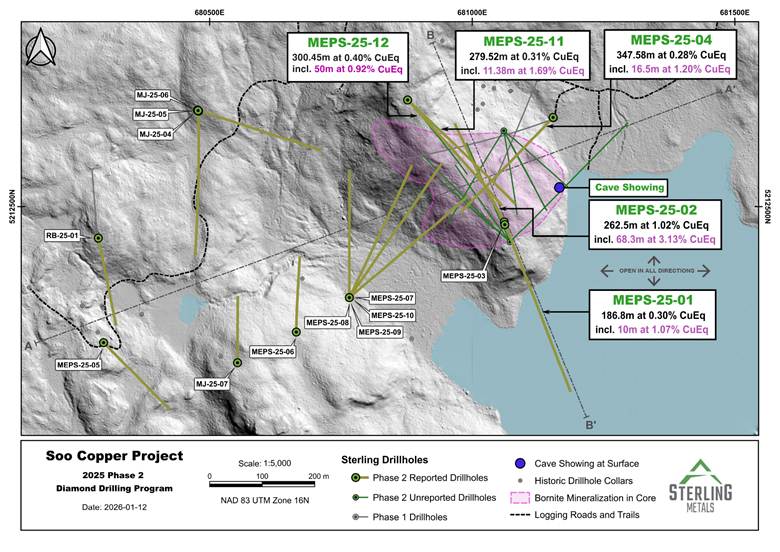
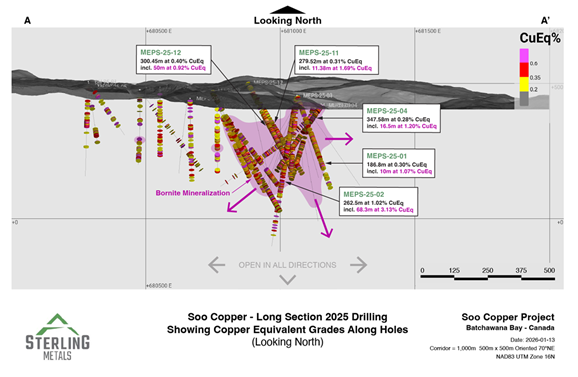
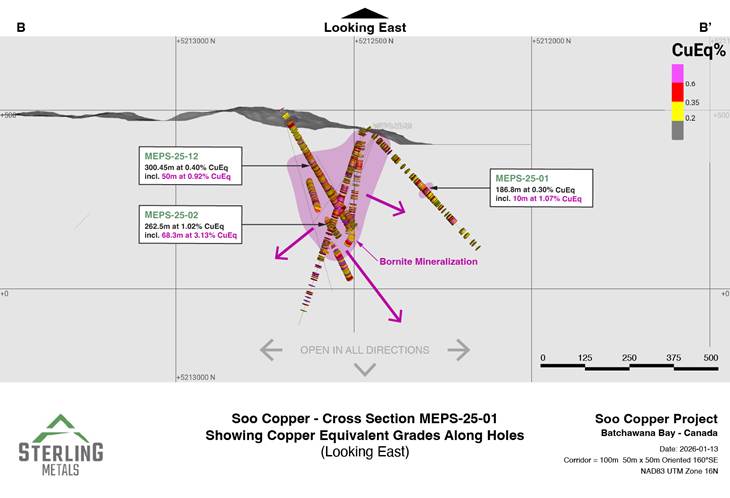
Building on the discovery made in MEPS-25-02, which confirmed a new style of high-grade copper-gold mineralization near surface, occurring approximately 200m south of the long, continuous copper interval in MJ-25-01 (see press release dated May 29, 2025), Sterling has demonstrated that the Soo Copper mineral system is substantially larger and richer than previously recognized, and that significant potential exists for an initial near-surface mineral resource that could be rapidly evaluated. Consequently, the Company accelerated its strategic plans by expanding the 2025 program, moving directly into a resource-exploration drilling program of the discovery area, and laying the foundation for a larger 2026 campaign.
MEPS-25-01 was drilled southwards away from the discovery area (Figure 3) and intercepted broad intervals of continuous porphyry copper style mineralization (e.g., 186.6m of 0.26% Cu including 26.8m of 0.58% CuEq) that extend a long way into a previously untested area to the south. This newly defined corridor of continuous copper-gold mineralization as well as a higher grade 10.0m interval grading 1.07% CuEq starting at 370.5m depth, opens up a large new zone that will be one focus of the Company's 2026 drill program.
It is thought that MEPS-25-02 drilled through the high grade bornite copper zone into a lower grade molybdenum-copper zone, demonstrating the presence of a large, metal zoned porphyry system. The high-grade zone crossed in MEPS-25-02 is still wide open to the east, south and at depth.
Drilling to the west of the MEPS discovery successfully followed the 1km long resistivity low corridor and corresponding soil geochemical trend, testing a 500m wide section of this structural geophysical target. Holes in this western area generally intersected broad intervals of copper mineralization dominated by chalcopyrite, with increasing pyrite and pyrrhotite content toward the west. Within this 1km by 500m drill window, the strongest copper grades continued to occur to the east, anchoring the centre of the bornite zone outlined earlier in the 2025 program.
A fan of drill holes (MEPS-25-07, 08, 09, and 10) completed in a valley directly west of the discovery area all intersected bornite, with holes closer to the discovery centre, particularly 07, 09, and 10, returning the widest intervals. These results extend the footprint of the bornite zone by approximately 250m to the west and demonstrate that the valley hosts the potential for both wide zones of copper mineralization and locally high-grade intervals. Holes MEPS-25-08 and MEPS-25-09 each returned high-grade copper hosted in chalcopyrite and associated with magnetite rich M-veins, including 0.25 m grading 9.28% CuEq in MEPS-25-08 and 0.30 m grading 15.73% CuEq in MEPS-25-09.
The valley holes also intersected extensive faulting, which appears to play an important role in localizing high-grade mineralization within the system. This structural preparation, combined with the continuation of bornite and high-grade copper farther west than previously demonstrated, provides a compelling new target corridor for follow-up drilling in 2026.
To date, 117 new samples returned assays exceeding 1.0% Cu from drill holes completed after discovery hole MEPS-25-02, demonstrating the potential for the nearby discovery of additional high-grade zones that will impact the resource development potential which has become an important focus of the Company. Additional assays from logged copper-mineralized drill intercepts remain pending and will be disclosed in a subsequent news release.
The Company continues target development work of additional copper mineralization centres across the property, including the Gimlet target (see press release dated October 8, 2025), where initial drill testing will be part of the 2026 drill program.
Jeremy Niemi, SVP Exploration, commented, "The combination of broad copper mineralization in MEPS-25-01 and the high-grade zones discovered in MEPS-25-02 made it clear that our copper system warranted a faster, more aggressive drilling approach. That's why we expanded our 2025 program and are preparing for a significantly larger 2026 resource exploration drill program. The 117 new samples over 1.0% copper - outside the original discovery area - illustrate that high-grade domains are emerging across multiple parts of the system."
Dr. Neil O'Brien, Chief Geologist, commented, "Drilling has indicated that the bornite-rich copper-gold mineralization is closely associated with the presence of the earliest porphyry ("GFP") dykes with the grades generally increasing towards the contacts with these dykes. While these mineralized GFP dykes have been intercepted in the majority of drillholes, some holes intercepting multiple dykes, additional drilling is required to establish the preferred orientation of these dykes and therefore the orientation of the very high-grade bornite mineralization. However, the drilling has confirmed that a broad halo of continuous bornite-chalcopyrite copper mineralization exists between, and away from these dykes, allowing for the potential development of a mineral resource that comes to surface."
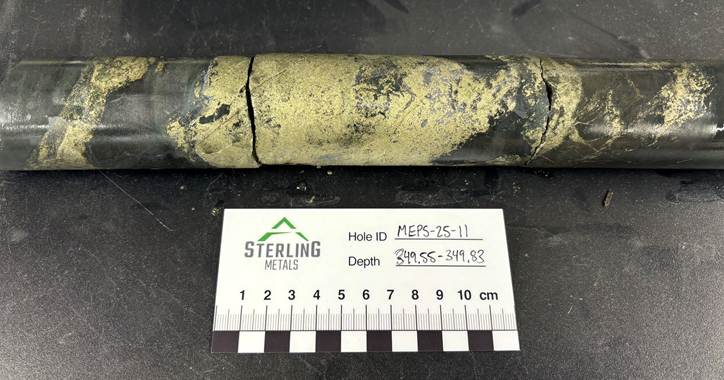
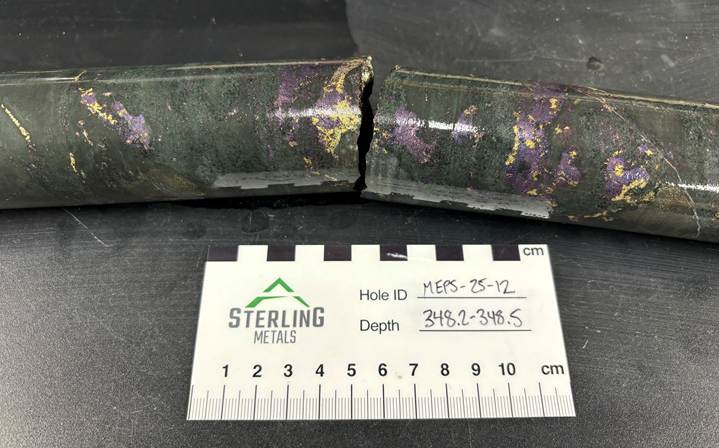
Table 1. Significant Assay Intervals
Drillhole | Zone | From (m) | To (m) | Length (m) | Cu (%) | Mo (ppm) | Au (g/t) | Ag (g/t) | CuEq (%) |
MEPS-25-01 | Central | 3.9 | 484 | 480.1 | 0.17 | 4.3 | 0.016 | 0.79 | 0.20 |
Including | 194.7 | 381.5 | 186.63 | 0.26 | 3.6 | 0.022 | 1.12 | 0.30 | |
Including | 213 | 260.5 | 47.5 | 0.40 | 4.1 | 0.019 | 1.77 | 0.44 | |
Including | 254 | 260.5 | 6.5 | 0.64 | 3.9 | 0.032 | 1.87 | 0.70 | |
Including | 354.7 | 381.5 | 26.8 | 0.48 | 8.5 | 0.088 | 1.34 | 0.58 | |
Including | 370.5 | 380.5 | 10 | 0.87 | 17.6 | 0.19 | 2.35 | 1.07 | |
MEPS-25-02 | Central | 5 | 341 | 336 | 0.43 | 43.5 | 0.39 | 2.75 | 0.83 |
Including | 47.5 | 310 | 262.5 | 0.52 | 46.6 | 0.49 | 3.15 | 1.02 | |
Including | 179.72 | 248 | 68.28 | 1.39 | 71 | 1.83 | 8.46 | 3.13 | |
Including | 181.25 | 181.65 | 0.4 | 13.3 | 3 | 1.03 | 22.9 | 14.5 | |
Including | 215.6 | 224.75 | 9.15 | 6.8 | 80.6 | 13.2 | 46.26 | 18.92 | |
Including | 219.85 | 220.45 | 0.6 | 21.3 | 2 | 196 | 168 | 193.85 | |
Including | 220.45 | 221 | 0.55 | 33 | 2 | 0.342 | 210 | 36.04 | |
And | 341 | 461 | 120 | 0.06 | 460.1 | 0.008 | 0.57 | 0.31 | |
MEPS-25-03 | Central | 1.12 | 318 | 316.88 | 0.16 | 33.1 | 0.017 | 0.5 | 0.20 |
Including | 78.25 | 147 | 68.75 | 0.28 | 13 | 0.023 | 0.89 | 0.32 | |
Including | 98.25 | 125 | 26.75 | 0.45 | 14.3 | 0.037 | 1.49 | 0.51 | |
Including | 105 | 111 | 6.0 | 0.94 | 7.3 | 0.079 | 3.86 | 1.06 | |
MEPS-25-04 | Central | 12.42 | 360 | 347.58 | 0.20 | 75.9 | 0.022 | 1.42 | 0.28 |
Including | 14 | 35 | 21 | 0.37 | 126.1 | 0.058 | 2.04 | 0.52 | |
Including | 162 | 328 | 166 | 0.30 | 18 |